If you have shadows under your eyes in front of the mirror, your makeup is uneven, or it’s hard to see details when shaving, the problem is usually not “a lamp that’s too weak,” but the wrong lighting solution as a whole. In the bathroom, several indicators matter at once: lumens (light output), lux (illumination on the face), Kelvin (light hue), CRI (color rendering index) and IP (humidity resistance). A good result does not necessarily mean the brightest light, but a correctly positioned and balanced system.
If you are planning to renovate the entire room, it is worth considering the lighting together with the furniture and layout. For example, the height of the mirror, the depth of the cabinets and the location of the sockets directly affect where the light can be installed. For this reason, it is useful to look at the lighting together with the bathroom furniture solutions , rather than choosing the lamp separately at the last stage.
Quick answer: How much light do you need in front of a mirror?
- Daily use: aim for 300-500 lx at face level.
- Precision makeup/shaving: aim for 500-750 lx at the face level.
- Color temperature: 3500–4000 K gives a natural and neutral result.
- CRI: Prefer CRI 90+ (minimum 80).
- IP protection: In the mirror zone, generally choose at least IP44.
In practice, this means that a solution where the total flux of the mirror's luminaire(s) is around 1000–2000 lm usually works well, but the final result depends on the size of the mirror, the wall surface and the luminaire placement.
Lumens vs. lux: why doesn't the package number alone tell the whole truth?
Lumen (lm) indicates how much light a light fixture produces. Lux (lx) indicates how much of that light reaches a specific point, such as your face in front of a mirror. The same 1200 lm can give very different results: a lamp mounted from above with a narrow beam creates shadows, a system with two side lights distributes the light more evenly.
A simplified rule of thumb for a mirror:
- Small mirror (up to ~60 cm): 800–1200 lm
- Medium mirror (60–90 cm): 1200–1800 lm
- Wide mirror (90+ cm / double): 1800–2500 lm
These ranges assume that the lighting is positioned so that it illuminates the face from the front or diagonally, not just from above.
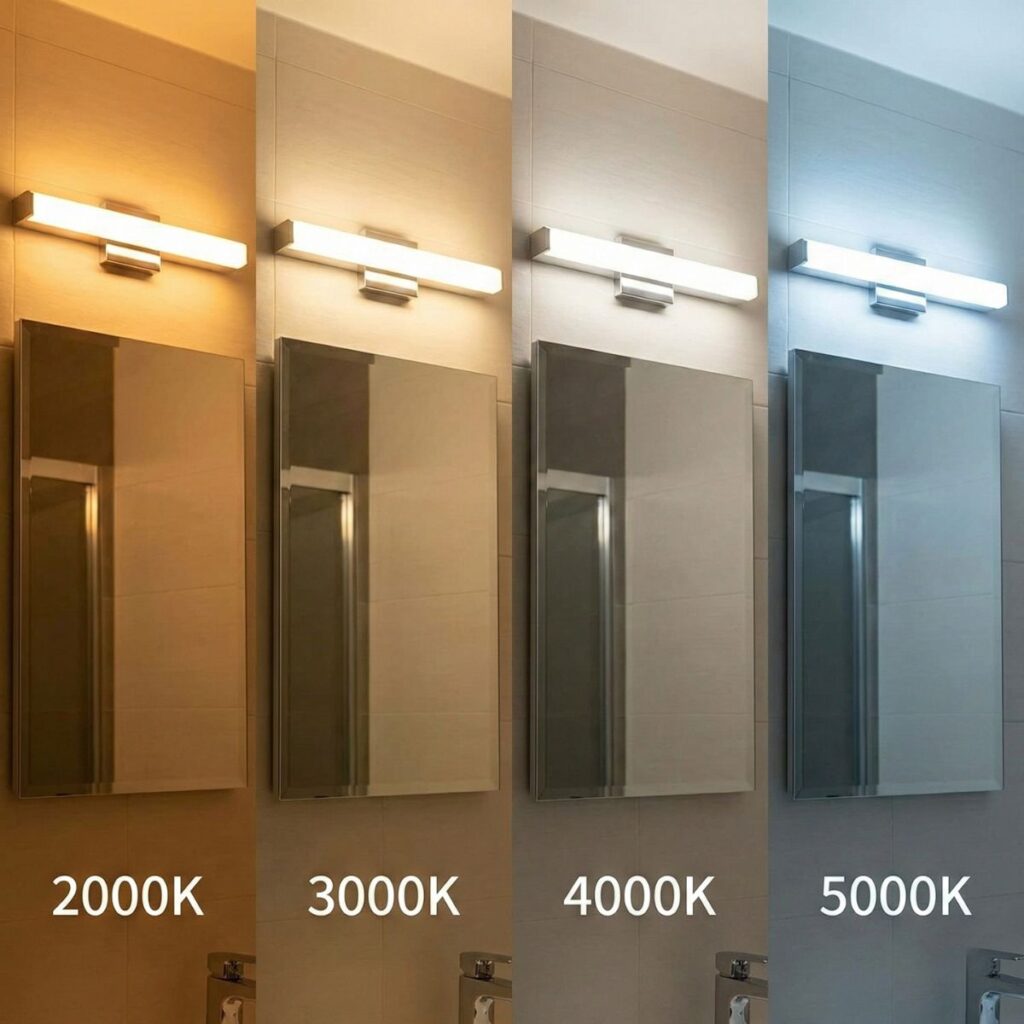
Kelvin (K): Which shade is most practical in a bathroom?
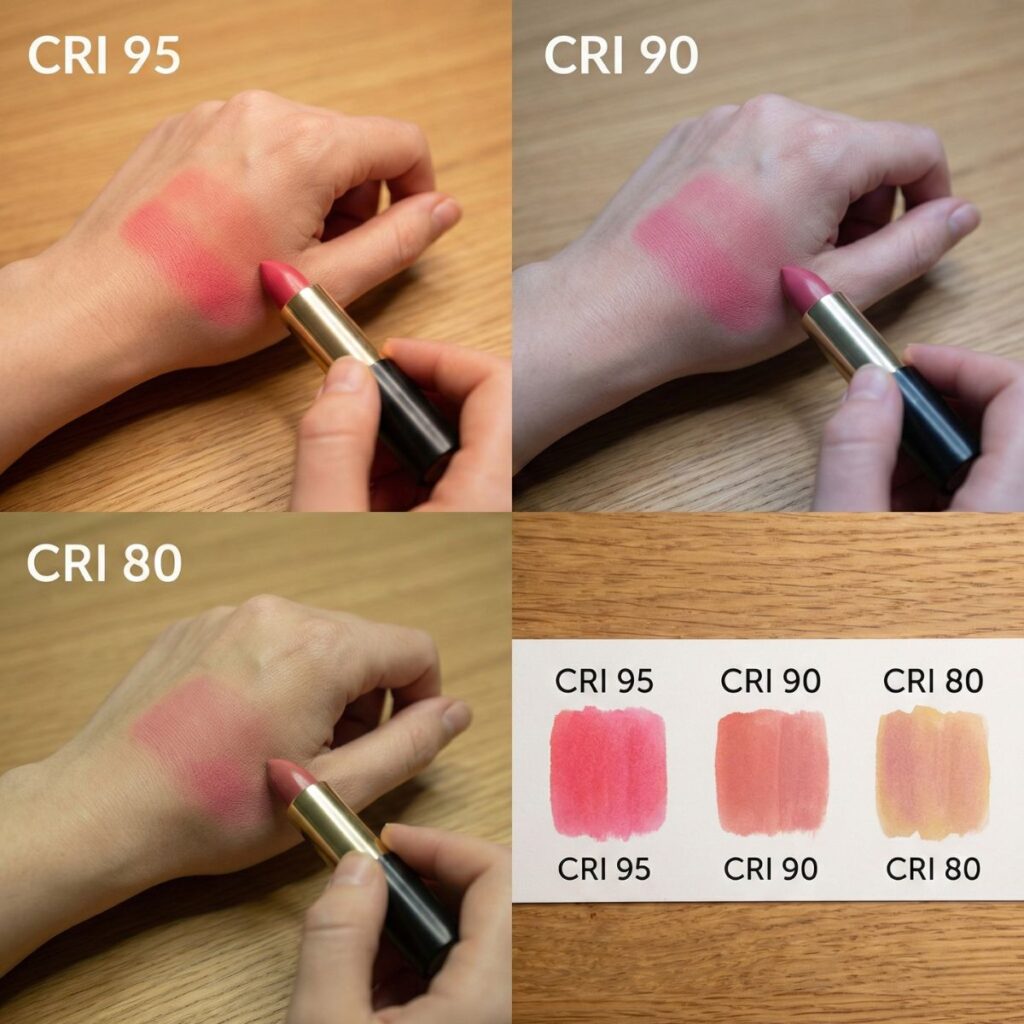
V CRI (Color Rendering Index) is a measure of how naturally the light renders colors. Low CRI light can make skin look “dead”, make-up tones inaccurate and make beard lines harder to read. A reasonable goal for a bathroom mirror is a CRI of 90+ , as this improves visibility and reduces the likelihood of errors.
If you have to choose between two similar lights, it is often a better decision in front of the mirror to choose a model with slightly lower lumens but a higher CRI. The quality of the result will be noticeably better in use.
IP protection: safety in damp rooms
The bathroom is a humid environment and the light fixture must have appropriate protection. Simply put:
- IP44: splash-proof, suitable for most mirror-surrounding installations.
- IP54/IP65: higher protection, a good choice if the light is close to a shower area or there is a lot of condensation in the room.
If you are planning a lighting area in close proximity to a shower or bathtub, it is worth following the requirements of the installer and electrician regarding electrical work. Safety should always be a priority, along with design.
CRI: the most underestimated indicator
V CRI (Color Rendering Index) is a measure of how naturally the light renders colors. Low CRI light can make skin look “dead”, make-up tones inaccurate and make beard lines harder to read. A reasonable goal for a bathroom mirror is a CRI of 90+ , as this improves visibility and reduces the likelihood of errors.
If you have to choose between two similar lights, it is often a better decision in front of the mirror to choose a model with slightly lower lumens but a higher CRI. The quality of the result will be noticeably better in use.
Layout: How to avoid shadows in front of a mirror?
The biggest mistake is having one strong ceiling light or a narrow light just above the mirror. This illuminates the head from above and creates shadows under the eyes and chin.
Workable layout solutions
- Two vertical side lights on either side of the mirror (height approximately above/below eye level).
- Backlit mirror + soft front light (for example, a wider overhead light) so that the face also gets direct light.
- Mirror cabinet with integrated LED light , when the light is directed forward, not just at the wall.
If you are renovating an entire area, you can integrate lighting and storage with the planning of bathroom furniture , for example, to avoid a situation where a beautiful light fixture is hidden behind a cabinet door or shelf.
Practical examples (decision-making in 5 minutes)
Example 1: small guest toilet
Mirror 50-60 cm, single user, quick maintenance. Start with 800-1200 lm total output, 3500-4000 K, CRI 90, IP44. If the room has dark tiles, choose the higher end of the range.
Example 2: Family bathroom
Mirror 80–100 cm, daily makeup and shaving. Aim for 1500–2200 lm, preferably with two light sources (side + top), 4000 K, CRI 90+, IP44 or higher. This will achieve better uniformity for users of different heights.
Example 3: Two-digit wide mirror
Mirror 120+ cm. Choose 2000–3000 lm and divide the light into at least two zones to ensure sufficient lighting for both users. Dimmer provides flexibility for evening use.
Summary: How many lumens do you really need?
For most homes, there is no “right number” but a workable range: around 1000–2000 lm at the mirror, more for larger solutions. The critical difference comes from where the light is directed and how high-quality that light is. If you want a solid result in front of a mirror, prioritize 300–750 lx at face level, 3500–4000 K, CRI 90+, and at least IP44. This combination works for both morning rushes and more detailed maintenance tasks.
- Don't choose a mirror light based solely on lumens — aim for the right lux .
- A universal and solid shade for most homes is 3500–4000 K.
- CRI 90+ is a worthwhile investment in front of the mirror, especially for makeup and shaving.
- In a humid zone, start with at least IP44 protection class.
- Side lighting or diffused front lighting reduces shadows much better than a single overhead light.
- For a large mirror, spread the light across multiple sources, rather than as one strong point.
FAQ: Bathroom Mirror Lighting
Is 4000K too cold for a bathroom mirror?
Mostly not. 4000 K is a neutral and practical choice that helps you see skin tones and colors realistically.
Is the LED strip on the mirror alone enough?
Often not. Backlighting sets the mood, but may not provide the direct light needed for the face. Combine backlighting with front lighting.
Which CRI is suitable for applying makeup?
A CRI of 90 or higher is recommended, as it reduces tonal errors and provides more accurate results in different daylight conditions.
Is IP44 always sufficient?
In a normal mirror area, often yes, but near a shower/bathtub, a higher degree of protection (e.g. IP54/IP65) may be required depending on the installation location.
Is a dimmer necessary?
Not mandatory, but very useful. With a dimmer, you can use the same light as both bright morning light and softer evening light.