
Imagine the situation: you have just completed an expensive renovation. The floor in your living room looks wonderful, perfectly matching the sofa. But just a year later, you notice faded spots on the walkways, scratches on the glaze in the hallway, and the patio tiles have cracked after the first winter. What went wrong? The answer lies in the technical specifications that are often overlooked on the store shelf.
Ceramic floor tiles are more than just a pretty surface. Each tile has its own "DNA" – a set of technical parameters that determine whether it's suitable for a cozy bedroom or a high-traffic hallway. While many homeowners already know the importance of slip resistance (you can read more about this in our article on slip-resistant tiles ), wear resistance, dimensional accuracy and water absorption are just as critical. In this article, we'll take a closer look at these parameters so you can choose a floor that will last for decades.
Wear resistance or PEI classes: how many steps can a tile withstand?
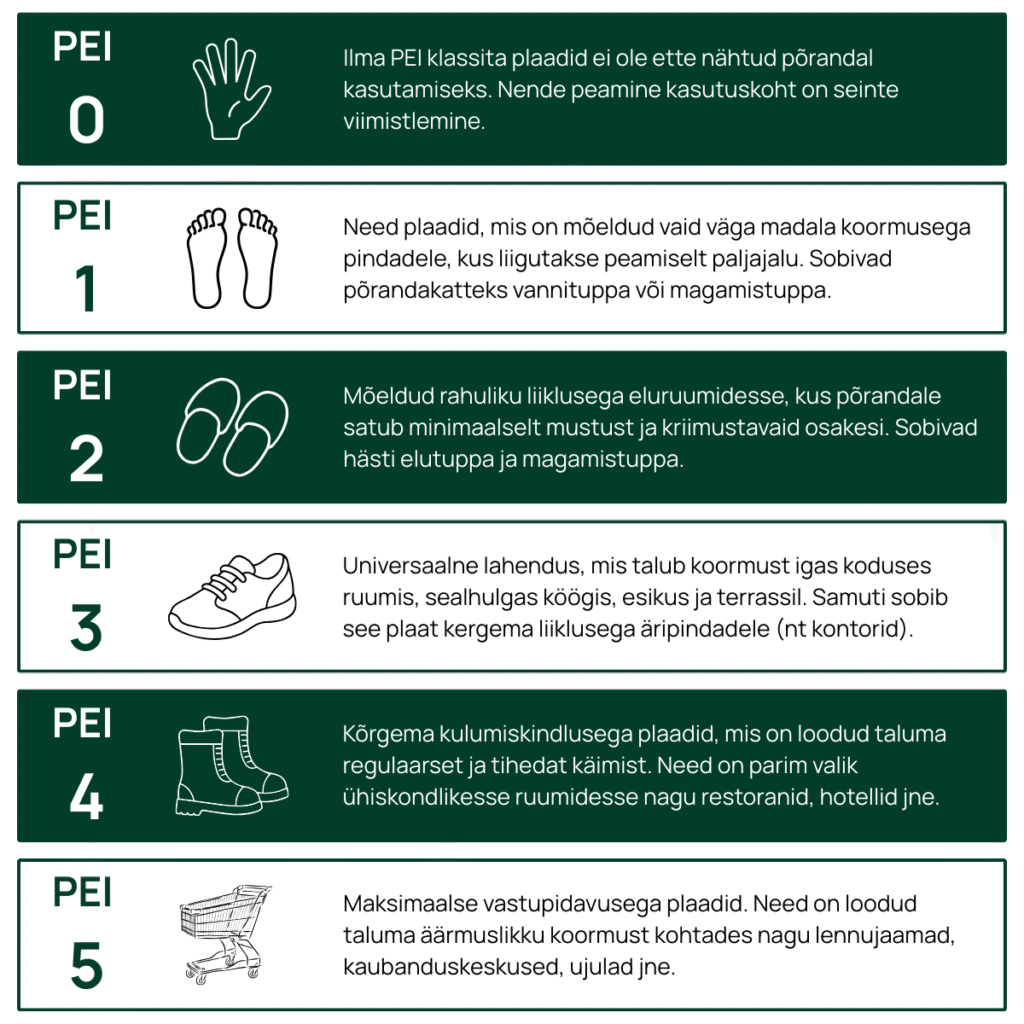
One of the most common misconceptions is that every floor tile is suitable for every floor. In reality, the abrasion resistance of glazed tiles varies greatly. It is measured on a PEI (Porcelain Enamel Institute) scale of 1 to 5. This indicator is critical because, unlike carpet or parquet, a worn tile cannot simply be "sanded over".
What do PEI numbers actually mean?
- PEI I and II (Light Duty): These tiles are primarily intended for walls or bathrooms where people walk barefoot or in soft slippers. If you install them in a hallway, the sand brought in by shoes will ruin the glaze in a matter of months.
- PEI III (Medium Duty): Suitable for most living spaces that are not directly accessed from the outside (e.g. bedroom, living room). This is a borderline choice for the kitchen, as there is more traffic and things falling.
- PEI IV (Heavy Duty): This is the "gold standard" for the active family. These ceramic floor tiles are perfect for entryways, kitchens, hallways, and patios. They can withstand muddy boots and pet claws.
- PEI V (Very Heavy Duty): Designed for shopping malls, hotel lobbies, and airports. They are "everlasting" for home use, but are often more limited in design options and more expensive.
Expert tip : Don't skimp on the hallway and kitchen. Always choose tiles with at least PEI IV class there. In the bedroom, you can safely use PEI III to gain access to a wider range of designs.
Material type: ceramic vs. full-body (porcelain)
When you look around the store, you'll see the labels " ceramic tile " and "solid-state tile" (often labeled as porcelain). While both are made from clay and fired in a kiln, their technical characteristics are drastically different.
Standard ceramic tile (single-fired/double-fired)
These are usually tiles pressed from red or white clay and covered with glaze.
- Pros : easier to cut, cheaper price.
- Cons : higher water absorption, more fragile. If you drop a heavy pot and a piece of glaze breaks off, the red clay underneath will show through, which is visually disturbing.
Full-body plate (porcelain)
This is a material where the color and structure run through the entire thickness of the board.
- Pros : Extremely dense and durable. If a chip occurs, it is barely noticeable because the interior is the same color as the surface. These are the best frost-resistant tiles for outdoor use.
- Cons : more difficult to install (requires a quality cutter), more expensive.
Glazed solid surface tile, which combines the strength of solid surface tile with the design possibilities of glaze, is also common today and is a popular choice among homeowners.
Rectification: why does it affect the appearance of a room?
Have you ever admired bathrooms in magazines where the tiles seem to form a single, almost seamless surface? The secret lies in the word "rectified".
Natural clay shrinks when heated in the kiln, so the dimensions of standard tiles can vary slightly from batch to batch and even within a single box. Their edges are often slightly rounded (pressed edge).
Rectified tiles have undergone additional processing after firing, where the edges are cut to size at an exact 90-degree angle with a diamond disc.
- Advantage : This allows the tiles to be installed with a minimal joint of 1–2 mm. The result is modern, smooth and visually spacious.
- Attention : Rectified tiles require a perfectly flat surface, as any unevenness can be felt with your feet and seen with your eyes due to the sharp edge.
Water absorption and frost resistance
In the Estonian climate, frost resistance is an indispensable issue if you plan to tile a terrace, balcony or unheated garage. Frost resistance is directly related to the tile's water absorption (marked E).
If the tile is porous and absorbs water, then at minus temperatures this water expands and breaks the structure of the tile – cracks appear or the glaze peels off.
- Indoor tiles (E > 10%): These absorb a lot of water and are only suitable for dry indoor spaces (usually wall tiles).
- Floor tiles (E < 3%): suitable for indoor floors.
- Frost-resistant tiles (E ≤ 0.5%): these are full-mass tiles (Porcelain) with almost no water absorption. They are the only ones that can withstand our winters.
Good to know : Low water absorption is also useful indoors. For example, in the kitchen, it means that spilled red wine or coffee will not soak into the tile and is easy to clean.
Tone variation or V-class
Have you ever bought a box of tiles, opened it at home, and discovered that the tiles are completely different colors? This is not a defect, but a design element, indicated on the V-scale (Shade Variation).
- V1 (uniform) : All tiles are identical. Creates a calm and minimalist surface.
- V2 (low variation) : slight differences in texture and tone.
- V3 (moderate variation) : one tile may be brownish, another grayish. This is typical for wood and stone imitations to achieve a natural result.
- V4 (high variation) : The tiles can vary drastically. This is an intentional effect to create a unique, variegated floor.
Be sure to check the V grade before making a purchase . If you want a "clean" gray floor, a V3 or V4 grade tile may be an unpleasant surprise.
Quick reminders
Ceramic floor tiles are an investment that should last for years, if not decades. By choosing tiles based solely on pattern and color, you risk a floor that will quickly become unsightly or crack with the first frost.
By making an informed choice and paying attention to technical specifications – especially wear resistance (PEI), frost resistance and dimensional accuracy – you will save yourself from headaches and additional costs later. Your home deserves a floor that is both beautiful and durable.
- PEI is king : Always choose PEI 4 or 5 for the hallway and kitchen. PEI 3 is sufficient for the bedroom.
- Frost resistance is mandatory : only tiles with a water absorption of less than 0.5% (full-mass tiles) are suitable for terraces and balconies.
- Joint width : If you want a modern, almost joint-free floor, look for the word "rectified".
- Avoid surprises : check the V-class (tone variation) to know how variegated the floor actually remains.
- Solid vs. Glaze : In high-traffic areas, opt for solid-mass tile where scratches won't show.
- Slip resistance : don't forget the R-class in wet rooms (see more in our other post ).
Frequently asked questions
Kas ma võin kasutada seinaplaate põrandal?
Üldjuhul mitte. Seinaplaadid on hapramad ja madalama kulumiskindlusega (sageli PEI I või puudub üldse). Nad võivad põrandal raskuse all puruneda ja glasuur kulub kiiresti maha. u003cstrongu003eVastupidi on aga lubatud – põrandaplaate võib alati seina paigaldadau003c/strongu003e.
Mida tähendab MOHS skaala ja kuidas see erineb PEI-st?
Kui PEI mõõdab kulumiskindlust (hõõrdumine, käimine), siis MOHS skaala (1–10) mõõdab kriimustuskindlust. Kui teil on suured koerad või liigutate tihti mööblit, otsige plaati, mille MOHS on vähemalt 7.
Kas rektifitseeritud plaate on raskem paigaldada?
Jah, need nõuavad kogenumat plaatijat ja väga hästi ettevalmistatud aluspinda. Kuna vuugid on kitsad ja servad teravad, on u0022hammasteu0022 (plaatide kõrguste erinevuste) tekkimise oht suurem ja need on kergemini märgatavad.
Miks on täismassplaadid kallimad kui tavalised keraamilised plaadid?
Täismassplaate põletatakse kõrgemal temperatuuril ja need sisaldavad kvaliteetsemaid tooraineid, et saavutada nullilähedane veeimavus ja suur tugevus. See tootmisprotsess on energiamahukam ja kallim, kuid tulemus on oluliselt vastupidavam.
Kas suuremõõtmelised plaadid (nt 60×60 cm või 60×120 cm) sobivad väikesesse ruumi?
Jah, suured plaadid võivad väikese ruumi visuaalselt avaramaks muuta, kuna vuuke on vähem ja pind on ühtlasem. Siiski tuleb arvestada, et väikeses ruumis võib tekkida rohkem lõikamisjääke.